Team America: World Police wasn't a Comedy. It was Documentary.
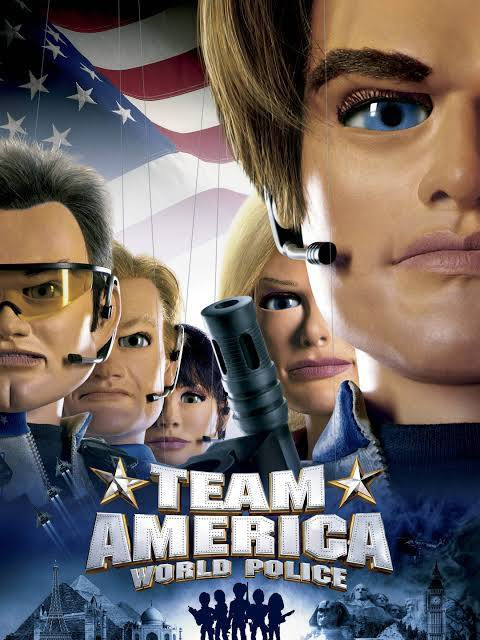
In 2004, Trey Parker and Matt Stone released a foul-mouthed puppet movie about America's obsession with policing the world. It was absurd. It was juvenile. It was also a pretty accurate forecast.
The premise of Team America: World Police is simple: a group of hyper-aggressive American operatives barrel across the globe destroying everything in the name of freedom — often causing more damage than the threats they were sent to neutralize.
They blow up the Eiffel Tower fighting terrorists. They level the Pyramids. Cairo, Panama, Paris — collateral damage, all of it, cheerfully accepted in the name of the mission. The theme song plays. America, f*** yeah.
Twenty years later, it doesn't feel like satire anymore. It feels like a documentary.
America Everywhere, All the Time, All at Once
The United States currently maintains approximately 750 military bases in 80 countries. Not 80 bases — 750 bases, in 80 countries. For context: no other nation on earth has more than a handful of foreign bases. The UK has about a dozen. China has maybe five. Russia has a few outside its own borders.
We spent 20 years and $2.3 trillion in Afghanistan. We spent $2 trillion in Iraq. Neither country looks like a victory. Afghanistan under Taliban control. Iraq is a fractured state with deep Iranian influence. The Islamic State — which didn't exist before we invaded Iraq — emerged directly from the power vacuum America created.
USA conducted drone strikes in at least seven countries...in 2026 lol. We have special operations forces deployed in roughly 80 nations in any given year. We've been involved in regime changes — overt and covert — in Iran, Guatemala, Congo, Chile, Libya, Syria, Ukraine, Venezuela and more. The list is long and not flattering.
The movie version blows up Paris and calls it freedom. The real version destabilizes the Middle East, creates a refugee crisis that reshapes European politics for a generation, spends $8 trillion doing it, and calls it "spreading democracy." Then wonders why nobody's throwing ticker-tape parades.
The Bill Nobody Wants to Look At
The U.S. national debt just crossed $36 trillion. The interest payments alone on that debt — just the interest — now exceed what America spends on defense. Let that land for a second. We are paying more to service the debt from past spending than we're spending on the military itself, which is also itself the largest military budget on earth...lmao.
The defense budget for 2025 was $886 billion. That's more than the next ten countries combined — China, Russia, India, Saudi Arabia, UK, Germany, France, South Korea, Japan, and Ukraine all together don't match what the United States spends on its military in a single year.
Meanwhile, back home, 45 million Americans carry student loan debt. About 650,000 people are unhoused on any given night. The average millennial has less wealth at 35 than their parents had at the same age. Infrastructure gets a D+ grade from the American Society of Civil Engineers. Bridges are literally collapsing.
Team America never worries about the budget. Real America is running out of runway.
"America, F*** Yeah" as Foreign Policy
The movie's funniest — and darkest — joke is that Team America genuinely believes it's the good guys. The destruction they cause is just a side effect. The locals who suffer collateral damage are unfortunate but necessary. The mission always justifies the cost — even when the mission changes, or fails, or was based on faulty intelligence, or was never clearly defined to begin with.
Sound familiar?
Iraq's weapons of mass destruction never existed.
Afghanistan's mission shifted so many times — from catching bin Laden, to defeating the Taliban, to nation-building, to training Afghan forces — that by the end nobody could articulate what winning even looked like.
Libya was a "humanitarian intervention" that left a failed state with active slave markets.
Syria became a proxy war where the U.S. armed multiple factions that were sometimes fighting each other.
Iran 2026. What's the mission?
Mission creep is the point. Once the apparatus is in motion — the contractors, the bases, the intelligence networks, the weapons systems, the careers built on perpetual conflict — stopping it is harder than continuing it. Eisenhower warned about this in 1961. "The military-industrial complex."
Nobody really listened.
Nobody Asked for This
Here's the part the movie gets exactly right that most foreign policy commentary misses: nobody wants Team America to show up (except Israel obviously).
Global approval of U.S. leadership has tracked inversely with U.S. military activity for decades. After 9/11, there was genuine global sympathy — for a moment, the world was with us. By 2003, after the Iraq invasion without UN authorization, that goodwill had evaporated. A 2023 Gallup poll found that in many regions — particularly the Middle East, North Africa, and Latin America — the U.S. is viewed as the greatest threat to regional stability, not a guarantor of it.
The movie's Kim Jong-il character — the puppet villain — makes a point that lands differently now than it did in 2004: the presence of Team America is itself a provocation. Showing up armed and certain doesn't create peace. It creates resentment, resistance, and eventually blowback.
The word "blowback" is actually a CIA term. It means the unintended consequences of covert operations that come back to harm the country that initiated them. We armed the Mujahideen in Afghanistan to fight the Soviets. Some of those weapons and fighters became the Taliban and al-Qaeda. Blowback is not a theory. It's a documented pattern.
Tickets to a Show We Never Wanted

Here's the part that should land personally for anyone in America:
Millennials came of age with the post-9/11 wars as background noise. We were in middle school or high school when the towers fell. We watched the Iraq War launch on live television. We were in college or our early twenties for the financial crisis — which was also partly debt-financed on the premise that we could afford everything forever.
The $8 trillion spent on post-9/11 wars? Brown University's Costs of War Project has calculated that when you include veterans' care — which continues for decades — the total bill will ultimately exceed $10 trillion. That debt belongs to us. It belongs to our kids. It's money that didn't go to infrastructure, to education, to healthcare, to the kind of domestic investment that might have meant we could actually afford to live in the country we grew up in.
Team America blows up the world and flies home. The puppets don't have student loans. They don't have $36 trillion in national debt sitting on their shoulders. They don't have to figure out rent. We do.
The Dicks, Assholes, and Pussies Speech (No, Really)
The most famous monologue in Team America — the one about dicks, assholes, and pussies — is crude and juvenile and also, weirdly, a decent framework for how American foreign policy actually operates.
The argument, stripped of the profanity: the world needs aggressive actors (dicks) to protect it from destructive ones (assholes), and the people who complain about the methods (pussies) are naive about what it takes to maintain order. It's basically the neoconservative foreign policy argument in puppet form.
The problem — which the movie kind of gestures at but doesn't fully reckon with — is that the dicks keep deciding unilaterally what counts as an asshole, and the definition keeps expanding to include anyone who has oil, or strategic location, or the wrong relationship with the wrong regional power.
The mission never ends because the mandate is infinitely expandable.
That's not security policy. That's empire.
Is There an Alternative?
This is where the conversation usually stalls. Point out that America is overextended and broke and creating blowback everywhere it goes, and someone will say: "So you'd rather China or Russia fill the vacuum?"
It's a real question. Unipolarity — one dominant global power — does create a certain kind of stability, even if it's enforced through coercion. The alternative, a genuinely multipolar world, comes with its own instabilities and risks.
But here's the thing: the choice isn't between "America everywhere forever" and "hand the world to Beijing." There's a lot of space between those poles that American foreign policy has never seriously occupied — genuine multilateralism, diplomacy-first approaches, using economic leverage rather than military force, investing in international institutions rather than bypassing them.
More practically: a country with $36 trillion in debt, crumbling infrastructure, and a generation that can't afford housing doesn't get to be the world's policeman indefinitely. The math doesn't work. The choice isn't ideological — it's arithmetic.
At some point, you have to come home and fix your own house.
The Bottom Line
Trey Parker and Matt Stone made a puppet movie about American arrogance, the inevitability of collateral damage, and the peculiar conviction that the rest of the world should be grateful for it. They meant it as a joke.
Two decades later, turns out the jokes on us.
The puppets were funnier. The bill is real. Freedom isn't free, no there's a hefty f***in' fee.
America, f*** yeah. Stay Frustrated

